

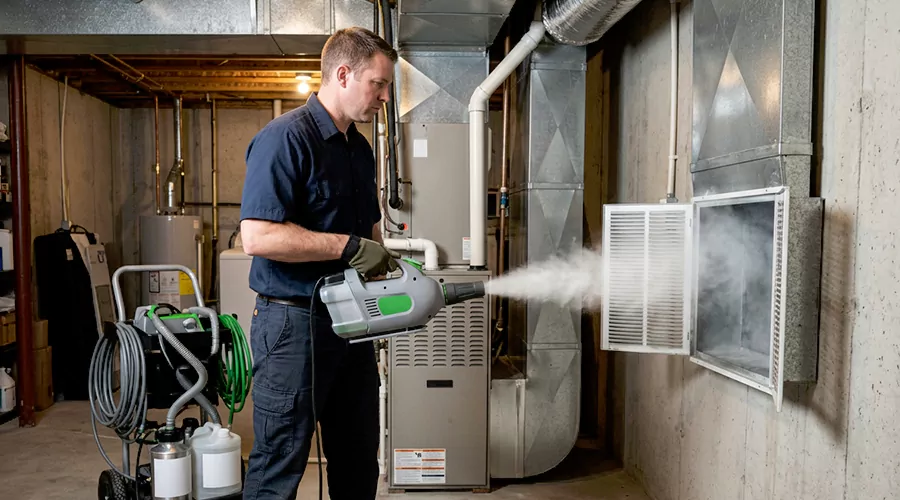
Fogging air ducts for mold distributes a fine mist of an antimicrobial chemical through selected parts of an HVAC system. The treatment is intended to affect microorganisms on surfaces that the product reaches. However, fogging does not physically remove established mold or repair moisture problems. Its effectiveness depends on the chemical used and whether the application follows its approved label.
Air duct fogging is sometimes offered alongside HVAC cleaning when microbial contamination is suspected. The process uses specialized equipment to turn a liquid treatment into small droplets that can travel through portions of the ventilation system. Some treatments are marketed as sanitizing or disinfecting services, although these terms have different meanings depending on the product's approved claims.
The important distinction is between treating microorganisms and removing contaminated material. Mold can remain attached to duct surfaces after a chemical treatment, and dead mold particles may still cause allergic reactions in susceptible people. Understanding what fogging can and cannot accomplish helps homeowners evaluate whether it has a useful role in a particular situation.
How Does Air Duct Fogging Work?
Air duct fogging uses equipment that disperses a liquid treatment into fine airborne droplets. The droplets move through the area being treated and may settle on exposed surfaces. The intended antimicrobial effect depends on the product reaching the target material at the required concentration and remaining in contact for the specified time.
The treatment is different from ordinary vacuum cleaning because it does not rely on physically collecting dust. A fogging machine distributes a chemical rather than removing debris from the ductwork. When mold is present, this difference matters because contamination may remain even if some microorganisms are affected.
How Fogging Equipment Produces a Mist
Fogging equipment breaks a liquid treatment into small droplets that can become suspended in air. Some systems use a process known as ultra-low-volume fogging, which creates a fine spray intended to disperse through a treatment area.
Droplet size influences how the mist travels and where it deposits. However, a fine mist does not guarantee that every internal duct surface will receive an effective amount of treatment. Airflow patterns and duct geometry can affect where droplets settle.
How the Treatment Reaches Duct Surfaces
The fog is introduced into designated parts of the HVAC system according to the equipment instructions and the chemical product's approved uses. Droplets may settle on exposed hard surfaces as the mist moves through the treatment area.
The amount of chemical reaching a surface depends on the application method and environmental conditions. Material hidden beneath dust or embedded inside porous insulation may not receive effective contact. This limitation is one reason fogging cannot replace the physical removal of contaminated material.
How Antimicrobial Chemicals Affect Microorganisms
Antimicrobial chemicals are designed to control specified microorganisms when used according to their labeling. Different products have different approved claims, which may include sanitizing certain hard surfaces or controlling particular fungi.
A product that works against one organism under laboratory conditions is not automatically effective against every type of contamination inside ductwork. The label must identify where the product can be used and provide the necessary application directions. Using a chemical outside its approved scope can create safety and legal concerns.
Does Fogging Actually Remove Mold From Air Ducts?
Fogging does not physically remove mold from air duct surfaces. An antimicrobial treatment may affect microorganisms that receive adequate exposure, but the material supporting established growth can remain. Dust deposits and contaminated insulation must be addressed through appropriate removal methods rather than chemical treatment alone.
This distinction matters because mold is more than a living organism attached to a surface. Established growth can leave particles and damaged material behind. Even when a chemical kills mold, remaining fragments may still cause reactions in susceptible people.
Physical cleaning removes material from suitable hard surfaces, while replacement may be necessary when contamination affects porous duct insulation. Fogging cannot restore damaged fiberglass or correct water entering through a leaking duct connection.
The appropriate response depends on the affected material and moisture conditions. Treating an otherwise clean hard surface under specific approved circumstances is different from attempting to fog an entire contaminated duct system without first removing established growth.
What Is the Difference Between Fogging and Air Duct Cleaning?
Fogging and mechanical duct cleaning serve different purposes. Mechanical cleaning is designed to loosen and collect dust or other deposits from HVAC components. Fogging distributes a chemical treatment that may affect certain microorganisms on surfaces the mist reaches.
Neither method automatically corrects a moisture problem. However, physical cleaning addresses deposited material directly, while fogging generally does not remove that material from the system.
| Feature | Air Duct Fogging | Mechanical Duct Cleaning |
|---|---|---|
| Main purpose | Apply an antimicrobial treatment | Remove dust and deposited debris |
| Primary method | Fine chemical mist | Agitation and controlled collection |
| Removes established mold material | No | May remove growth from suitable hard surfaces |
| Restores moldy fiberglass insulation | No | No |
| Repairs water leaks | No | No |
| Depends on chemical label restrictions | Yes | Generally not applicable |
| May be appropriate for confirmed contamination | Only under specific conditions | Depends on material and contamination |
The comparison shows why chemical fogging should not be presented as equivalent to physical mold removal. A cleaned surface and a chemically treated surface are not necessarily the same.
For example, mold growing on damp debris inside a sound metal duct requires removal of the contamination and correction of moisture. Spraying the same area without removing the debris leaves material behind. A complete response must address the cause and the affected surface.
Can Fogging Kill Mold Spores Inside Air Ducts?
Certain antimicrobial products can affect specified fungi when they are applied to approved surfaces under the required conditions. However, the ability to control microorganisms depends on the exact product and its label directions. It should not be assumed that any fogging chemical will kill every mold spore throughout an HVAC system.
The concept of contact time is particularly important. A chemical may need to remain on a surface for a specified period to achieve its approved effect. A mist passing through a duct does not automatically establish that the required contact conditions have been met.
Contaminated dust can also interfere with antimicrobial activity. Some products work best on surfaces that have already been cleaned, because deposits may prevent the chemical from reaching the target microorganisms. This is another reason mechanical removal cannot simply be replaced with fogging.
Complete sterilization of residential ductwork is not a realistic or necessary goal. Mold spores naturally exist in indoor and outdoor environments. Keeping duct surfaces dry is more important for preventing new growth than attempting to eliminate every airborne spore.
What Are the Limitations of Fogging Moldy Air Ducts?
Fogging has several limitations because a chemical mist cannot perform the same work as physical cleaning or material replacement. The most significant concern is that visible contamination may remain after treatment. The process also cannot correct water problems that allow mold to develop.
Fogging Cannot Remove Moldy Insulation
Internally insulated ducts may contain fiberglass or other porous materials. When mold develops within these materials, it can extend beneath the visible surface. Applying a chemical mist does not physically remove that contamination.
Wet or moldy fiberglass duct material generally needs replacement because it cannot be cleaned effectively. Chemical treatment should not be used as a substitute for removing material that has been damaged by moisture.
Fogging Does Not Correct Condensation
Condensation develops when humid air contacts a sufficiently cold surface. A chemical treatment cannot change the conditions that allow water droplets to form. If cold ducts remain poorly insulated or indoor humidity stays elevated, moisture can return after treatment.
The same limitation applies to clogged condensate drains. Fogging cannot restore proper drainage or stop water entering a duct through a damaged connection. Moisture correction must be addressed separately.
Mist May Not Reach Every Surface
Duct systems contain bends and different surface textures that can influence how a mist travels. Some areas may receive more treatment than others, while material hidden beneath deposits may receive limited contact.
A fogging procedure should not be assumed to cover every concealed component simply because mist entered the duct system. Effective antimicrobial treatment depends on the approved application method and required surface contact.
Chemicals Can Create Exposure Concerns
Introducing antimicrobial chemicals into ventilation systems requires careful consideration of potential exposure. Some occupants may react to chemical residues or vapors. Products also differ in their required ventilation precautions and conditions for reoccupying treated spaces.
Ozone should not be considered a harmless alternative. It is a lung irritant and should not be introduced into occupied indoor environments as an ordinary duct-cleaning method.
Are Fogging Chemicals Approved for Use Inside HVAC Ducts?
Some antimicrobial products have EPA registrations for specific uses on the interiors of bare sheet metal ducts. However, product registration does not mean a chemical is approved for every HVAC surface. The exact treatment method and intended use must appear on the product's label.
Federal pesticide requirements prohibit using registered antimicrobial products in ways that conflict with their labeling. A general disinfectant approved for household countertops is not automatically suitable for use inside ventilation ducts.
Internally insulated duct systems require particular caution. EPA guidance identifies no registered biocides for treating mold in internally insulated ductwork. Contaminated fiberglass materials should not be treated as though they are equivalent to bare metal surfaces.
Before any antimicrobial treatment is considered, several details should be established:
- What is the exact name of the proposed product?
- Does the product have an EPA registration number?
- Does its label permit the intended HVAC application?
- Is the affected duct bare metal or internally insulated?
- Has visible contamination already been physically removed?
- What contact time does the label require?
- What occupant precautions apply during treatment?
- How will the moisture source be corrected?
These questions are useful because the phrase "EPA-registered product" can be misunderstood. Registration applies to specific uses under defined conditions. It does not automatically prove that fogging will remediate an entire mold-contaminated HVAC system.
Can Fogging Prevent Mold From Coming Back?
Fogging cannot reliably prevent mold from returning when the underlying moisture problem remains unresolved. Mold growth depends on water availability and suitable materials. Even if a treatment affects existing microorganisms, new growth can develop when damp conditions continue.
Condensation is a common example. Cold supply ducts may repeatedly become wet when humid air reaches exposed surfaces. Treating those surfaces with a chemical does not repair damaged insulation or control the humidity responsible for the condensation.
A similar problem occurs with condensate drainage. Water that continues collecting near the cooling coil can support contamination in affected materials. The long-term solution is to restore proper drainage and remove materials that cannot be cleaned.
Preventing recurring mold is therefore primarily a moisture management task. Chemical treatment cannot replace corrective maintenance.
What Problems Might Fogging Fail to Solve?
Fogging may be ineffective when the apparent mold problem is actually caused by damaged materials or unresolved moisture. It may also be unnecessary when dark deposits are ordinary household dust rather than fungal growth. Confirming the condition before treatment helps avoid an inappropriate response.
| Problem | Why Fogging Is Insufficient | More Appropriate Focus |
|---|---|---|
| Moldy fiberglass insulation | Growth remains in porous fibers | Remove affected insulation |
| Condensation on cold ducts | Moisture conditions remain unchanged | Correct insulation and humidity |
| Clogged condensate drain | Water continues collecting | Restore drainage |
| Heavy dust deposits | Chemical mist does not remove debris | Physical cleaning when justified |
| Damaged duct connections | Air leakage remains | Repair duct joints |
| Ordinary dark dust staining | Mold may not be present | Identify actual deposit |
| Water-damaged drywall | Porous material may remain contaminated | Evaluate affected building material |
The table illustrates why identifying the original problem matters. A dark stain on a ceiling vent may result from airflow-related particle deposits rather than mold. Fogging such a system would not address the source of the stain.
Likewise, a damp duct liner cannot be restored simply by exposing it to a chemical mist. The condition of the material determines whether removal or replacement is necessary.
Is Fogging Safe for People Living in the Home?
The safety of an antimicrobial fogging treatment depends on the product and how it is used. Some chemicals require specific ventilation or reentry precautions. The fact that a product is marketed for indoor use does not mean every application method is appropriate for an occupied home.
Antimicrobial products can have different effects depending on concentration and exposure conditions. Children and people with respiratory sensitivities may require particular consideration. Product labels should describe the precautions needed during application and before normal use resumes.
Homeowners should avoid attempting improvised duct fogging with household disinfectants. General cleaning sprays are not designed to be introduced into concealed ventilation passages. Spraying chemicals into a running HVAC system can distribute the material into occupied rooms.
A chemical's safety profile must be considered alongside its actual benefit. When there is no confirmed microbial contamination, exposing a ventilation system to an antimicrobial treatment may provide no meaningful advantage.
How Much Does Air Duct Fogging Cost in 2026?
Air duct fogging does not have one reliable nationwide price because treatment may be offered separately or included within a broader cleaning project. Costs also depend on the product and the size of the HVAC system. A fogging charge should not be confused with the price of complete mold remediation.
Published U.S. estimates for 2026 place standard residential duct cleaning around $271 to $509. Mold remediation specifically involving ductwork commonly costs $600 to $2,000, while extensive HVAC contamination can cost $3,000 to $10,000. These figures describe broader services rather than a verified stand-alone fogging price.
| Service | 2026 Cost Context | Main Purpose |
|---|---|---|
| Standard air duct cleaning | $271 to $509 | Remove ordinary dust and debris |
| Air duct inspection | $140 to $380 | Evaluate duct conditions |
| Mold remediation in ducts | $600 to $2,000 | Address confirmed contamination |
| Extensive HVAC remediation | $3,000 to $10,000 | Address larger contamination problems |
| Antimicrobial fogging | No consistent stand-alone national benchmark | Apply a specific approved treatment |
A low-cost fogging service should not be assumed to replace a more involved remediation project. The cost difference often reflects the fact that fogging does not physically remove damaged insulation or address concealed water problems.
Comparing prices is meaningful only when the scope of work is clear. Chemical treatment and physical contamination removal should be identified separately within any proposed project.
When Should You Call an HVAC or Mold Remediation Professional?
Professional evaluation is appropriate when substantial suspected mold appears inside HVAC ducts or on internal equipment components. Contaminated insulation and persistent water problems also require assessment. The main objective is determining whether physical cleaning or material replacement is necessary before considering chemical treatments.
A qualified HVAC technician can examine moisture conditions and assess accessible duct materials. When significant fungal growth is confirmed, an experienced mold remediation specialist may determine how affected components should be cleaned or replaced. The approach should prevent the unnecessary spread of contaminated particles.
If fogging is proposed, ask why physical removal and moisture correction are not sufficient. Request the product label and an explanation of the intended treatment surface. A credible recommendation should make clear what the chemical can accomplish and what it cannot.
A proposal based only on an unexplained musty odor or ordinary dust staining does not establish a need for chemical treatment. The affected material and actual contamination should determine the work.
How Can You Prevent Mold Without Relying on Fogging?
Preventing mold in air ducts is primarily a matter of keeping the HVAC system dry. Condensation and water intrusion provide conditions that allow fungal growth. Regular maintenance helps identify these problems before internal materials become contaminated.
Maintain Proper Condensate Drainage
Air conditioning systems remove moisture from indoor air through the cooling coil. The collected water should leave through the condensate drainage system. Inspect accessible drainage areas for standing water or overflow during routine maintenance and correct problems promptly.
Control Indoor Humidity
Use a hygrometer to monitor indoor relative humidity and aim for approximately 30% to 50% when practical. Excess indoor moisture increases the likelihood of condensation on cold surfaces. Managing bathroom humidity and other moisture-producing activities can help reduce that risk.
Protect Duct Insulation
Check accessible ductwork for damaged insulation or disconnected sections during regular HVAC maintenance. Supply ducts in unconditioned spaces should be protected from humid air contacting cold surfaces. Repairing insulation problems reduces repeated condensation that could support future growth.
Address Water Leaks Quickly
Roof leaks and plumbing problems can wet duct materials even when the HVAC equipment operates correctly. Repair water intrusion promptly and dry affected materials within 24 to 48 hours when possible. Porous insulation that becomes moldy may need replacement instead of repeated treatment.
Maintain Filtration
Inspect HVAC filters during periods of heavy system use and replace them according to manufacturer instructions. Proper filtration reduces particle accumulation on downstream components. However, even an effective filter cannot prevent mold when water remains present.
Conclusion
Fogging air ducts for mold applies an antimicrobial mist but does not physically remove established contamination. Its effectiveness depends on the product and approved application conditions. Moldy insulation and ongoing moisture problems require different solutions. Chemical treatment should never replace source removal or water correction. When significant contamination exists, professional assessment can identify the appropriate approach. This week, check for moisture problems before considering any duct treatment.